
Student Privacy · FERPA Enforcement
DOJ Sues Kansas District for FERPA Violations: How We Got Here
The KCKPS FERPA lawsuit is the farthest a federal student-privacy enforcement action has ever advanced. Here's how it happened.
1 Kansas Attorney General Investigation2 Defense of Freedom Institute Complaint to USED3 USED Initiates FERPA & Title IX InvestigationsDistricts Respond to USEDUSED Finds Districts NoncompliantResolution Attempts and USED's EscalationFirst DOJ LetterThe KCKPS and DOJ ExchangeResolution Agreement and Further EnforcementDOJ Sues KCKPS4 What's Next?
Yesterday, the U.S. Department of Justice (DOJ) Civil Rights Division and U.S. Attorney for the District of Kansas filed a “first-of-its-kind” lawsuit against Kansas City, Kansas Public Schools (KCKPS) alleging the district is violating the Family Educational Rights and Privacy Act (FERPA) and the Protection of Pupil Rights Amendment (PPRA). This is a pivotal moment for student privacy, as no FERPA enforcement action by the U.S. Department of Education (USED) has made it to the litigation stage before. And that’s not all: last week USED announced that it is also partnering with DOJ to take enforcement action (including possible lawsuits) against two other Kansas districts, Olathe Public Schools (OPS) and Shawnee Mission School District (SMSD).
To understand how we got to this point, we need to look back and revisit how interactions between four Kansas school districts, state and federal regulators, and third parties unfolded over a three-year period. This blog attempts to do just that: weaving together several events and resources to tell a more complete story, encompassing the broader underlying narrative as told in their own words.
The resources and events described in this blog also include allegations related to Title IX. For the purposes of this blog, we are only focusing on student privacy issues and allegations under FERPA and PPRA.
Kansas Attorney General Investigation
KS AG Letters to Districts
On December 7, 2023, the Kansas Attorney General (KS AG) sent letters to six school districts and the Kansas Association of School Boards (KASB) outlining concerns about district policies potentially preventing transparency with parents about their child’s transgender status and asking questions related to this issue. These letters referenced specific district policies as well as reporting from The Sentinel that at least 3 KS school districts hide students’ transgender status from parents, which cites a Defending Education list of school districts that allegedly have transgender or gender nonconforming policies saying district personnel can or should keep a student’s transgender status hidden from parents.
Click through the following images to see examples of district policies the KS AG referenced in their letters.

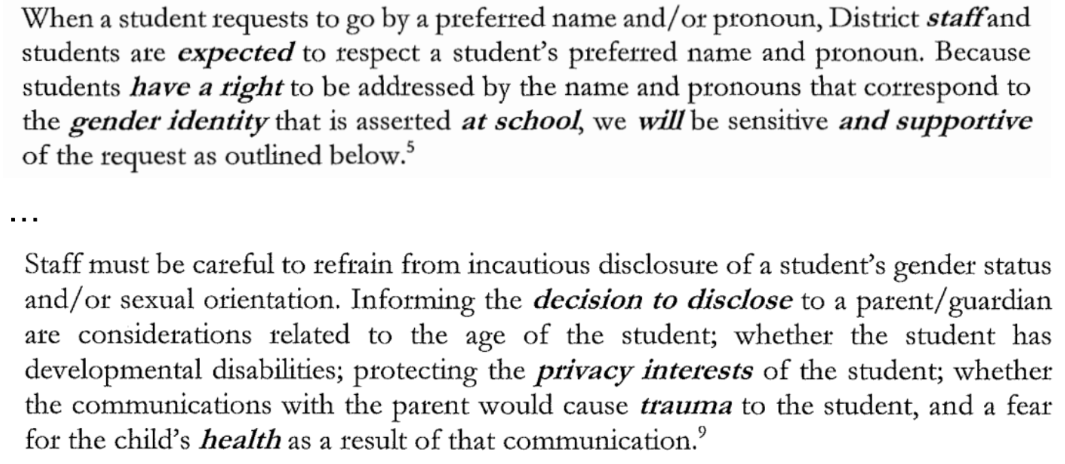
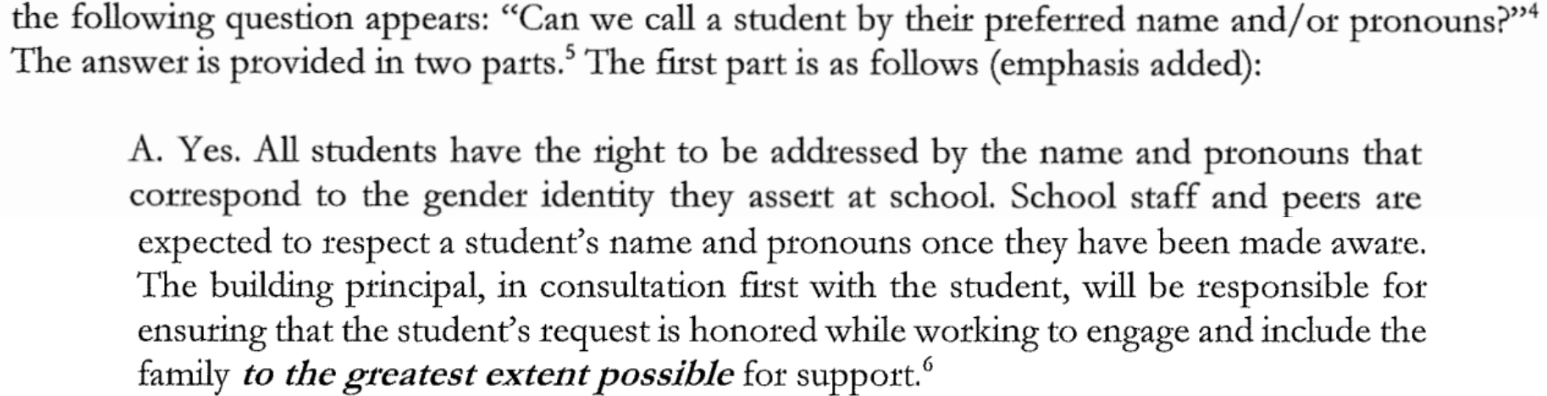
SMSD Letter
In response to the KS AG’s inquiry, SMSD sent a letter1 on December 19, 2023 clarifying that “The District does not have a policy specific to transgender students, nor a policy on ‘disclosing’ requests by transgender students for supports and accommodations, to their parent/guardian,” but rather that “School administrators work with transgender students on a case-by-case basis using an approach that is appropriate for the unique circumstances.” SMSD wrote:
“[The KS AG’s] letter appears to be primarily informed by misinformation from inconspicuously partisan sources, as well as by incorrect assumptions about our administrator guidance for working with transgender families. The answer to [the KS AG’s] inquiry is that, regardless of whether a request for supports and accommodations is initiated by a transgender student or by their parent/guardian, building administration works to assemble an appropriate team to develop a plan for the student, with both the parent/guardian and the student on the team.”
While acknowledging that “District-level administration drafted the guidance document that [the KS AG] refer[s] to in [their] letter,” SMSD’s letter noted that “A review of that document shows that any plan for a transgender student would be developed through discussion and conversation with the student and their parents/guardians.”
KS AG News Release
On February 8, 2024, the KS AG issued a news release, School districts 'socially transitioning' students without parental consent, despite AG warning. The release stated:
“Upon receiving the [KS AG’s] letter, two school districts—Belle Plaine (USD 357) and Maize (USD 266)—responded that they had no intention of cutting parents out of the process and immediately rescinded or amended their policies."
"The four remaining districts, however, dug in their heels and essentially asserted that school administrators know better than parents. Those remaining schools were Kansas City (USD 500), Olathe (USD 233), Shawnee Mission (USD 512), and Topeka (USD 501). Some schools denied that their policies cut parents out of the picture, but the Attorney General's letters quote the offending language directly from those schools' policies. Olathe requested a meeting to discuss the issue with the Attorney General's Office, but despite repeated attempts by the Attorney General's staff, no such meeting has been scheduled.
Kobach also sent a letter to the Kansas Association of School Boards (KASB) based on evidence that KASB may have been involved in promoting policies that push parents out of the way on this issue. KASB declined to either confirm or deny that it had been involved in drafting such policies.”
Defense of Freedom Institute Complaint to USED
On June 24, 2025, the Defense of Freedom Institute (DFI) sent a FERPA and Title IX Complaint to USED alleging that four Kansas school districts—the same four districts identified in the KS AG’s February 8, 2024 press release—were violating the Family Educational Rights and Privacy Act (FERPA). Specifically, the complaint cited the same district policies discussed in the KS AG’s December 7, 2023 inquiry to allege that the districts violate FERPA by “authorizing their employees to conceal information from parents and disseminate such information among their colleagues regarding requests by their minor children to alter the names and pronouns used by staff to refer to them throughout the school day to align with their ‘gender identity’ rather than their biological sex.”
FERPA is a federal privacy law that protects the privacy of students’ personally identifiable information (PII) in education records. FERPA primarily does two things: ensures appropriate access and limits unauthorized disclosure. Access is embodied through FERPA’s guarantee that parents and eligible students (students 18+ or attending higher education institutions) have the right to access their education records and to challenge information in those records they believe is inaccurate, misleading, or otherwise in violation of the student’s privacy rights. FERPA prohibits all other disclosures of PII in education records unless there is consent or an applicable exception to FERPA’s consent requirement and certain safeguards are in place. For more information on FERPA, see our FERPA FAQs here.
DFI's Complaint Identifies Two Primary FERPA Concerns
1. Concealing education records from parents
The complaint alleges that “policies, guidance, and related materials or evidence in unwritten communications show that [each] district is suggesting that its employees conceal from parents the records of their minor child’s request to change the name or pronouns by which he or she is referred in school.” (emphasis added) But notably, the complaint does not allege any specific instances where education records were actually withheld from parents. Instead, it says that “If school employees are withholding education records from parents of minor children on the basis of these factors, then they are violating FERPA.” (emphasis added)
DFI’s complaint references an ongoing lawsuit, Sullivan v. USD 512 Shawnee Mission, where Sullivan (an English teacher at SMSD since 2007) alleges that SMSD announced a “policy prohibiting teachers from disclosing to a student’s parents when a student requests pronouns that are divergent from the sex of the student and preventing teachers from disclosing to a student’s parents when a student requests to be called a name that might suggest a divergent gender” at a “mandatory PD session” in 2023.
In her complaint, Sullivan alleges that the defendants “are also demanding that Ms. Sullivan implicate herself by lying to parents to hide from parents when their child is experimenting at school with different pronouns or genders…requir[ing] Ms. Sullivan to hide this critical information from parents despite Ms. Sullivan’s religious and moral beliefs against lying, and despite the [KS AG]’s express warning that the [SMSD]’s policy demanding teachers to hide the critical information from parents likely violates the law. Sullivan claims that she “does not want to and will not lie to parents,” but “feels threatened by Defendants if she does not follow District policy or custom to hide information about students from their parents.”
DFI’s complaint goes on to allege that the districts’ “policies and guidance require employees to withhold critical information from parents about the existence of such records,” effectively “establish[ing] a system of obfuscation where employees may work behind closed doors with minor students to create education records that parents know nothing about, thus frustrating the parents’ exercise of their FERPA rights.” To support this claim, DFI alleges that:
“The OPS Guidance explicitly requires employees to cut parents out of the process of changing a student’s name and pronouns in certain circumstances, and the Sullivan Complaint alleges that it is an unwritten policy of SMSD to do the same. The KCKPS Training, offered to the school board and in numerous professional development sessions in the school district, tells employees not to inform minor students’ families about their desire to change ‘gender identities’ at school, and it envisions the creation of an ‘individual transition or support plan’ for each student who makes such a request with or without parental involvement. KCKPS and TPS explicitly require employees not to use the ‘preferred’ name of a student in correspondence with his or her family and not to inform parents about their minor children’s ‘gender identity’-related requests if the student declines to authorize or if the law does not specifically require disclosure.”
DFI also discusses how KCKPS and TPS policies differentiate between (1) a "mandatory permanent pupil record” (aka “official record”) that includes a student’s legal name and gender, and (2) other types of records that can “be amended to reflect the student's preferred name and gender identity." This distinction does not appear in FERPA. FERPA applies to personally identifiable information (PII) in education records. Education records are records: 1) directly related to a student; and 2) maintained by an educational agency or institution, or by a party acting for the agency or institution (34 CFR 99.3). Upon request, schools must give parents access to all of their child’s education records, regardless of whether district policy regards them as “official” or “unofficial” records.
2. Sharing student gender identity information with school staff without parental consent
The complaint also alleges that “all four of the Kansas school districts discussed in this letter have provided for the sharing of records and information related to students’ ‘gender identity’ with school staff absent the written consent of parents in violation of this provision of FERPA.” To support this claim, DFI cites examples such as:
“Students’ rights under [KCKPS Guidelines and TPS Regulations] to be referred to by their preferred name and pronouns and to access sex-separated restrooms that align with their ‘gender identity’ also strongly imply that student personal information is shared throughout the school building to ensure they are not ‘deadnamed’ or prevented from entering certain intimate facilities. No parental consent is required under these policies for the distribution of such information…
The OPS Guidance provides that school administrators should support a student’s request to go by a preferred name or pronouns at school, even in at least some cases when the family does not agree (or know about) the request. The SMSD Guidance similarly contains no requirement that school administrators obtain the consent of a student’s parents before informing teachers and other school staff that the student wishes to go by a preferred name or preferred pronouns.”
The complaint then correctly notes that “If carrying out any of these policies involves informing individuals of a minor student’s personal information contained in his or her educational records without obtaining the consent of the student’s parents, then such action entails violating FERPA unless it falls within one of the exceptions listed in the statute.” DFI argues that such disclosures do not fall within FERPA’s school official exception because “it is extremely difficult to see how any staff member’s interest in a student’s ‘gender identity’ is ‘educational,’ much less ‘legitimate’.” That being said, there are several other FERPA exceptions and exemptions not addressed in DFI’s complaint (see our lists of them here and here) that should also be examined on a case-by-case basis.
KS AG Letter to USED
On the same day that DFI filed its FERPA and Title IX complaint, the KS AG also sent a letter to USED to “draw [USED’s] attention to a recent filing from [DFI] requesting an investigation of four Kansas school districts with such ‘gender identity’ policies that actively undermine parental rights and contravene federal law.” The KS AG wrote that they “respectfully urge [USED] to review the harmful and illegal district policies described in DFI’s letter and open an investigation of these school districts’ failure to comply with FERPA and Title IX by concealing critical information from parents about their children’s psychological and emotional health, and by requiring students to share sex-separated intimate spaces with individuals of the opposite sex.”
In response to the KS AG’s letter to USED, OPS issued a news release stating that:
“As a district, it is always our practice to work directly and partner with families and students as situations arise to ensure we are providing the appropriate and necessary support. To be absolutely clear, it is our expectation that staff work directly with families regarding student-related matters involving their own child(ren). [OPS] does not and has never socially transitioned our students.”
OPS’s statement said that the district’s superintendent and staff counsel met with two attorneys from the KS AG’s office on March 26, 2024, and that the KS AG did not attend.2 OPS says that in the meeting, “the district repeatedly sought clarity…regarding specific changes that they believed should be made by the district” and “asked the [KS AG] to identify specific situations involving [OPS] students, staff or families that they were aware of in which the district was not following state or federal laws.” However, OPS states that “the [KS AG] would not provide specific input or information regarding any alleged violations of state and federal laws by the district,” and that:
“Due to the limited information shared by the [KS AG], the district was left with no actionable information to make change. Despite the district’s willingness to remedy any concerns, the result of the meeting and overall interaction left the district feeling as though they were part of a larger political agenda.”
USED Initiates FERPA & Title IX Investigations
On August 14, 2025, USED announced that it launched FERPA and Title IX investigations into TPS, SMSD, OPS, and KCKPS: the same four districts identified in the DFI complaint. In the press release, Secretary McMahon said:
"The Kansas districts' alleged behavior of allowing gender ideology to run amok in their schools is an affront not only to the law, but to the sound judgment we expect from our educational leaders. School personnel should not confuse and unsettle young girls by forcing them to share sex-separated sports and intimate facilities with boys; nor should school personnel abuse their position of authority by hiding sensitive information pertaining to a child's health and wellbeing from that child's parents…From day one, the Trump Administration promised to protect students and parents by restoring Title IX and parental rights laws to the fullest extent of the law. My offices will vigorously investigate these matters to ensure these practices come to an end."
While the Department's press release did not link to the official investigation initiation letter(s), it explicitly referenced DFI's complaint and mentioned the KS AG's letter. To the best of our knowledge, the Department's FERPA allegations against TPS, SMSD, OPS, and KCKPS are similar to those raised in DFI's complaint.
Districts Respond to USED
Joint letters
On August 29, 2025, the four districts sent a joint letter to USED asking “clarification on multiple points in order to respond with fidelity to the Data Requests,” including “whether there is a pending parent/guardian complaint alleging a FERPA violation against any of the School Districts” and details of such complaints. The districts communicated that they “are unable to submit a response to the Data Requests within the nine business day deadline set forth in [USED’s] August 22nd letter” and requested an additional 90 days to respond after receiving the requested clarifications from the Department. However, as explained in the following footnote from the districts’ second joint letter, the districts “encountered difficulties” when trying to get this information from USED:
“On August 29, 2025, the School Districts requested the Department provide information about any complaint, complainant, and policies related to its letters. To date, the Department has not provided any information. The Department’s response stated only that ‘[r]equests for records must be submitted in accordance with [FOIA].’ When the School Districts submitted their September 5, 2025 FOIA request, the Department’s September 8, 2025 letter indicated that ‘the current average request processing time is 185 business days.’ Given that the Department denied the School Districts’ request for an extension beyond an additional 14 days, the Department has created a near-impossible situation under which the School Districts must respond to the Data Request without sufficient information. When the School Districts receive responsive information under FOIA, each School District reserves the right to supplement its response to the Data Request within a reasonable time following receipt of such information.”
We have not yet seen a copy of the Data Requests that USED sent to the districts. However, excerpts from the districts’ joint response to the Data Requests provide hints as to what FERPA-related information may have been requested:
- “The School Districts do not respond to requests to inspect or access education records of students in attendance at the School Districts differently for any parent, including parents of transgender students.”
- “The School Districts have asked the Department to identify any complainants or individual students for which a Title IX or FERPA complaint has been filed, so that they can search for responsive records. Without the identity of a complaint or specific student, the School Districts have no ability to search for any records or correspondence concerning any informal complaints.”
- “In response to request no. 24, the School Districts state that they have never ‘charged a fee to a parent to search for or to retrieve … any records related to a student’s gender transition status or plan or related accommodations.”
(September 19, 2025, Attachment A to the second joint letter)
In the first joint letter, attorneys for the districts noted that they are “amenable to meeting with [USED] to discuss the requested points of clarification and to provide information about the School Districts’ practices with regard to working with transgender students and their families.” In the second joint letter, the districts requested a meeting with USED “to explore voluntary resolution.” The districts “provide additional information that clearly explains why a meeting would be extremely important and necessary here,” acknowledging:
“(1) we are willing to proceed with either mediation or a meeting to explore voluntary resolution (as the Department deems appropriate), (2) the nature of the applicable case law under Title IX, (3) the importance of an oral, interactive discussion regarding the Schools Districts’ policy, procedure, or guidance documents, and (4) how our response to your Data Request may need to be updated once we receive the information we requested from the Department.”
While awaiting the additional information from USED, the districts responded to USED’s FERPA-related concern about the disclosure of student’s gender identity, writing:
“The Department’s August 14, 2025 notification letters state that each ‘[School] District has a policy that prevents school officials from disclosing a student’s ‘transgender status’ to the student’s parents unless authorized by the student, in violation of [FERPA].’
This statement is both confusing and inaccurate. The applicability of FERPA is at best unclear or more likely -- not applicable -- given that the School Districts do not maintain information about gender identity in their education records of students in attendance. The School Districts only maintain information about students' sex (M or F), as recorded on their birth certificate, in their education records of students in attendance. Additionally, the School Districts have no such policies. In stark contrast to the Department’s statement, the School Districts have enacted policies ensuring their compliance with FERPA, as noted below in Attachment A in the response to the Data Request.”
SMSD letter
On April 10, 2026, SMSD sent a letter to USED providing additional details about the district’s FERPA-related practices. SMSD explains that USED’s original “concern with FERPA compliance stemmed from [an] FAQ, which is no longer in effect,” but instead was replaced by new guidance when SB 244 passed.3 SMSD says that the district’s “compliance with FERPA and its mandate of parental access to educational records is illustrated by the SMSD Preferred Name & Gender Consent Form,” which requires parental consent to name and gender identity changes “in public-facing SMSD publications like yearbooks, newspapers, and the website.”
SMSD goes on to state that:
“During our recent telephone conversation, you expressed the belief that SMSD maintains ‘shadow files’ of educational records that have not been provided to parents. You did not cite any specific student and were unwilling to identify the evidence supporting that allegation. We have made inquiries regarding this specific allegation of FERPA non-compliance and found no such evidence to support it. SMSD does not maintain ‘shadow files’ or otherwise prevent parents of minor children from accessing student records. SMSD has not received any formal complaints from parents regarding access to student records. SMSD has not and will not withhold documents from parents, and SMSD continues to comply with FERPA, as stated in their Policy IDEA and Policy JR. Accordingly, we see no basis for a resolution agreement to require any changes to SMSD policy regarding FERPA. We see no basis for any enforcement action absent specific evidence of FERPA violations, which we have not identified.”
OPS Letter
On April 17, 2026, OPS sent a letter to USED stating that: “The District has been, is, and agrees to continue to be, in compliance with FERPA requirements regarding providing parents with access to their student’s education record, consistent with FERPA.” OPS says that:
“During our discussions from January through April 2026, the District has confirmed that staff and teachers have not, currently do not, and would not, maintain more than one education record for a student. Moreover, in response to [USED]’s inquiry, the District confirmed that it has not ever maintained a separate education record regarding a student’s gender identity. At [USED]’s request, the District updated its Guidance to add language that its annual orientation training for staff will include the FERPA requirements regarding parent access to the student’s education record maintained by the District.”
In our research, we have not been able to locate a KCKPS or TPS response during this period.
USED Finds Districts Noncompliant
Also on April 17, 2026, USED announced their determination that the four Kansas districts have policies that violate FERPA. The press release says:
“Based on a lack of substantive documentation submitted by the Districts, SPPO found that the Districts had policies that were likely to prevent schools from notifying parents of their child’s so-called ‘gender transition,’ even if the parent requested their child’s records, thereby violating parents’ rights under FERPA to access school records pertaining to their children. The Districts’ policies allow schools to conceal from parents whether their children are using different pronouns, going by different names, or even having different names printed on their diplomas.”
USED notes that it has “issued proposed Resolution Agreements to the Districts” specifying actions to remedy FERPA violations, including (but not limited to): “The Districts will inform school personnel that ‘gender support plans’ and other related documents having to do with a student’s so-called ‘gender transition’ will be made readily available and accessible to parents and guardians.” The press release did not link to the proposed Resolution Agreements.
Following the announcement, OPS submitted a resolution agreement to USED in May 2026, which included a commitment from OPS to inform all personnel that any such document “would generally be an education record under FERPA, and therefore, subject to review and inspection by the parents of a student.” However, the district announced on June 11, 2026 that USED rejected that agreement (more details included below).
USED’s press release also contains a finding specific to one district: “OCR also concluded that [KCKPS] denied OCR access to information in violation of federal law.” That finding concerns OCR’s own access to information during the investigation, not parents’ access to records.
USED’s press release states that district policies were likely to prevent parents from accessing their children’s education records upon request, but does not allege any specific instance where parents were affirmatively denied records they asked to see. In our research, we have not identified specific allegations of records being withheld from parents related to this investigation.
That being said, we did see that KCTV5 reported the Community Conscience Action Network (CCAN) alleged in a letter that “a district compliance officer refused to give an immigrant family their child’s education records on June 1, when the family was trying to withdraw from the district.” The article stated that “CCAN said the [DOJ letter and this incident] show a broader pattern of denying parents access to records ‘without documented legal basis.’”
District responses
We could only find substantial information related to two of the four districts’ responses to USED’s notice of noncompliance.
TPS and KCKPS both provided brief statements to The Sentinel, saying in part:
- TPS: “USD 501 has always complied with [FERPA] and honored parents’ right to access education records and information regarding their student. The district does not withhold or hide any student educational records from parents,” while expressing concern “with the manner in which this matter has been communicated publicly prior to a full and collaborative resolution process.”
- KCKPS: “KCKPS disagrees with [USED]’s determination which is not supported by the facts or law…KCKPS has acted and will continue to act in full good faith compliance with all applicable federal and state laws, including Title IX and FERPA.” The statement notes that “KCKPS is dedicated to fostering a safe, supportive learning environment where every student can thrive. KCKPS will continue to work in partnership with students, parents and guardians to ensure open, respectful communication that supports student well-being and academic success.”
SMSD: Rejected Voluntary Resolution Agreement
Initial News Release
On April 20, 2026, SMSD issued a news release where the district claims that: “Since submitting the April 10 letter, SMSD has received no direct communication from the OCR and learned of their findings only after seeing the press release posted on their website.” SMSD wrote:
“The OCR finding was premature, not based on evidence, and potentially damaging to SMSD’s ability to continue to provide excellent services to all students. Rather than engage with SMSD and discuss the relevant facts and case law, OCR has chosen to act upon rumor and hearsay. Their press release, issued prior to any direct communication to SMSD, shows that the outcome of their ‘investigation’ was pre-determined. The SMSD has fully cooperated throughout this process and given the facts it shared with the OCR fully expected to be cleared from these allegations. Instead we read online misinformation such as: ‘[SMSD] also has policies regarding participation in sports that raise significant compliance concerns.’...this allegation is meritless. Despite repeated requests, OCR has not provided SMSD with any evidence that demonstrates unlawful conduct or in any way supports the OCR allegation. To the contrary, it seems as if OCR was determined to issue their so-called ‘findings’ of a Title IX violation regardless of any information provided by SMSD. The truth doesn’t seem to matter to the Department, as they are determined to pursue a political agenda by antagonizing a school district despite its clear compliance with law. It seems as if OCR has written a ‘playbook’ and we are simply pawns in this narrative.”
The district acknowledged that the path forward is uncertain, but stated in the news release that SMSD is prepared to argue the case in court if need be:
“It is unclear what steps [USED] will take in response to its faulty process and unfounded ‘finding’ of violations of federal law. If the Department seeks to withhold federal funds from SMSD, we will vigorously protect our right to those funds in court. Any such attempt to rescind or withhold funds will suffer from both substantive and procedural defects. There is no legal basis for any enforcement action, and the Department has not gone through the requisite procedural steps necessary to withhold federal funds. Again, SMSD is prepared to make these and other allegations in court and defend both our funds and our adherence to the rule of law.”
Letter to USED
On May 4, 2026, SMSD then sent a letter to USED reiterating their position that the investigation “was a sham process designed to reach a predetermined outcome untethered to the facts or controlling standards of law.” The district wrote:
“We were disappointed to receive [the Letter of Findings and accompanying draft Resolution Agreement], as they contain inaccurate statements of law, false allegations of fact, and unreasonable conditions required for voluntary resolution of this investigation. Contrary to [USED’s] findings, SMSD is in full compliance with [Title IX, FERPA] and Kansas state law…SMSD has been fully cooperative with your investigation and strongly disputes the allegation that the District has ‘intentionally failed to provide [USED] with access to sources of information to determine [SMSD’s] compliance with Title IX and FERPA during the investigation’...Finally, the Resolution Agreement you have provided contains provisions that are inconsistent with the values that inform our work of supporting all children in our communities. SMSD will not agree to the voluntary resolution agreement on the terms you’ve set forth.”
Regarding FERPA, SMSD argued that USED “points to neither a policy nor practice inconsistent with the requirements of FERPA,” and that the Letter of Findings “points to not even one instance in which a parent was prevented from accessing educational records.”
The district explicitly refuted two of USED’s FERPA-related findings. First, SMSD rebutted USED’s finding that: “[P]olicies set forth in SMSD’s former FAQ document, specifically that school staff and peers are expected to respect students’ chosen names and pronouns and that a transgender student’s decision about what name appears on their diploma will be honored, violates FERPA.” SMSD asserts that “nothing about SMSD’s approach to student names, pronouns, or gender violates or even implicates FERPA,” arguing that USED’s finding is flawed for three reasons:
- It “is no longer timely” because the FAQ document was rescinded;
- “[P]rioritization of student choice over parents’ preference in terms of name change is not covered by FERPA, which rather provides parental access to educational records” and
- “SMSD involves parents when students make a request to change their name and/or gender in their education records and requires signed parent/guardian consent.”
Second, SMSD refuted USED’s finding that: “[F]ailure to mention FERPA in the 2026 Guidelines and the absence of ‘documentation demonstrating that the aforementioned FAQ document was formally rescinded,’ constitutes a FERPA violation.” SMSD noted that USED “does not allege a violation of any specific provision of the FERPA statute” here, arguing that “[f]ailure to mention FERPA in a guidance document is not a violation of FERPA” and that “SMSD maintains separate policies setting forth the requirements of FERPA.” The district also rebutted USED’s claim that the 2026 Guidelines did not formally rescind the district’s prior FAQ by asserting that “the 2026 Guidelines document itself…plainly states: ‘This document replaces the previous guidance document titled ‘Transgender Practices and FAQ.’’”
OPS: (Attempted) Voluntary Resolution Agreement
On May 9, 2026, the Kansas City Star reported that “The Olathe district approved a voluntary resolution agreement at its Board of Education meeting Thursday, and the superintendent signed it Friday. The agreement doesn’t admit wrongdoing, the district says, but agrees to take action on concerns raised by the department.”
The May OPS resolution agreement includes the following FERPA-related provisions:
- “[OPS] will issue a memorandum to all [OPS] personnel informing them that [OPS] has not had and does not have ‘gender support plans’ but that if there were such a document that is directly related to a student in attendance at [OPS] and which is maintained by [OPS], such a document would generally be an education record under FERPA, and therefore, subject to review and inspection by the parents of a student.”
- “[OPS] has revised its guidance to include language sufficient to support the implementation of [provision A], and shall revise such guidance to the extent any current policy might contradict the statement from [provision A].”
- “[OPS] will submit documentation that will ensure that future [OPS] personnel annual FERPA training includes content that aligns with [provisions A and B].”
- By October 1, 2026, OPS will provide USED with:
-
- “Documentation reflecting that the memorandum was issued and/or posted on [OPS]’s website as described in [provision A].”
- “Copies of any updated guidance reflecting [provisions A and B], and an assurance that its practices are aligned with [OPS]’s guidance.”
- “Documentation of training materials and corresponding revised guidance, if applicable, as described in [provisions A and B] including a link(s) to the location where such are posted.”
- Annually by June 1, 2026, 2027, and 2028, OPS will certify that:
- “All information related to a student that is maintained by [OPS], whether in official or unofficial files, is considered generally an education record under FERPA, and is therefore, subject to review and inspection by the student’s parents” and
- Related policies “are posted prominently on [OPS]’s website, along with a link to each policy.”
OPS News Release
On June 11, 2026, OPS issued a news release stating that: “Despite the district's full cooperation throughout the process and good faith effort to bring this matter to a reasonable conclusion, [USED] has rejected the signed agreement and has sent a notice of enforcement actions.” In response, OPS detailed how their strategy has changed, writing:
“Faced with the threat of losing critical federal funding or being referred for litigation, the district has been placed in a position that feels less like a collaborative effort to resolve concerns and more like an attempt to strong-arm the district into accepting allegations and remedies it does not believe are supported by the facts or the law.
[OPS] will now shift its focus to defending our school system through any and all legal avenues to ensure we continue to receive federal funding, protect our district and the students we serve, and ensure the record reflects the truth: [OPS] has always been in compliance with both Title IX and FERPA. We will not allow inaccurate allegations or politically driven narratives to undermine the work of our staff, the trust of our families, or the educational opportunities available to our students.”
USED Letters to Districts
On June 11, 2026, USED announced that it sent “Letters of Impending Enforcement Action to [OPS], [SMSD], and [TPS to] notify the Districts that they have 10 calendar days to come into compliance or face enforcement action, potentially including referral to [DOJ] and the termination of federal funding.” The Department also sent a “Letter of Impasse to [KCKPS] notif[ying] the District that the Department is preparing for impending enforcement, which, following the Department’s regulatory procedures, could result in the termination of the Districts’ federal education funding.” The press release does not link to the letters. Under OCR’s Case Processing Manual, a Letter of Impasse informs a recipient that a Letter of Impending Enforcement Action will be issued in 10 calendar days if a resolution agreement is not reached within that period.
On June 15, 2026, USED and DOJ signed an Inter-Agency Agreement (IAA) assigning DOJ’s Civil Rights Division a role in enforcing the FERPA “in coordination with” USED, acting through its Student Privacy Policy Office (SPPO). See this blog for more information on USED’s IAAs.
USED Announces First FERPA Enforcement with DOJ
On June 30, 2026, USED announced that SPPO will work with DOJ’s Civil Rights Division to “take appropriate enforcement measures, including applicable judicial proceedings and potential loss of federal funding, for [KCKPS]’s failure to substantially comply with the requirements under FERPA.” (emphasis added). The press release alleges that:
“The District maintained a policy stating that school personnel ‘should not disclose information that may reveal a student’s transgender status or gender nonconforming presentation to others, including parents.’ SPPO’s investigation revealed clear evidence that District administrators positively reject their legal responsibility to honestly answer parents’ inquiries about their children’s health and wellbeing. Despite the Department’s proposed Resolution Agreement, which outlined specific actions the District should take to remedy their FERPA violations, the District continues to ignore federal parental rights law.”
KCKPS Statement
On July 1, 2026, KCKPS issued the following statement:
“[KCKPS] acknowledges the recent announcement by [DOJ] and [OCR] regarding the district.
KCKPS respectfully disagrees with the federal agencies’ conclusions and maintains that the district has acted in good faith and in accordance with applicable federal and state laws.
KCKPS remains committed to complying with all applicable federal and state laws, including the Family Educational Rights and Privacy Act (FERPA).
The district is also committed to fostering a safe and supportive learning environment where every student can thrive. KCKPS will continue working in partnership with students, parents, and guardians to ensure open, respectful communication that supports student well-being and academic success.”
First DOJ letter
On July 21, 2026, the DOJ sent a letter 4 to KCKPS “constitut[ing] a formal demand and a final opportunity to cure [FERPA violations] before litigation may be initiated.” The letter states:
“We are aware of a recording that reveals [the KCKPS Assistant Superintendent of Organizational Development] referring to a ‘transgender guideline,’ which another unidentified person refers to as a ‘document’ (the ‘Transgender Guideline’). [The Assistant Superintendent] asserts that the Transgender Guideline is not made available to the school community but is instead safeguarded by certain ‘gatekeepers.’ Additional recordings reveal (1) [the Assistant Superintendent] discussing secret policies, conversations, and other non-specified efforts that are deliberately hidden from public view; and (2) [a] KCKPS Organizational Development Specialist] discussing her willingness to obscure information from a student’s father based on the father’s religious affiliation.”
On March 26, 2025, Heartlander News reported that “Staff and union leaders at [KCKPS] have been caught on a [March 12] video call strategizing how to secretly advance LGBT agendas in classrooms under a rebranded DEI department.” Heartlander News alleged that one participant characterized the discussion as “Underground Railroad conversations” with “Vegas rules,” and the reporter describes “the need for secrecy” as a recurring theme. Though FERPA is not mentioned, the article reports the conversation “addressed the use of pronouns preferred by students and sexual identity ‘coming out’ experiences, all of which they agreed must be hidden from parents who disagree,” with a participant asking: “Where can we find the loopholes?” and “Where can we sneak things in?”
The government argues that KCKPS actions “create and enforce a policy that denies or effectively prevents parents from exercising their statutory right to inspect and review their children’s education records,” since “a categorical prohibition on disclosure of that information to parents absent student authorization renders parents’ right to inspect and review those records meaningless.” It adds: “Worse, a coordinated, secret campaign waged by school administrators to bypass the requirements of the law reveals outright hostility to the rights FERPA protects.”
The letter instructs KCKPS to take the following actions within 14 days (by August 4th) to avoid potential litigation:
- "Cease all enforcement of the Transgender Guideline (and any regulations, guidelines, or practices) that prohibit or restrict the disclosure of information concerning a student’s transgender status, gender identity, sexual orientation, preferred name, or preferred pronouns to the student’s parents or guardians.
- Evaluate all KCKPS policies, guidelines, and practices to ensure they protect and promote parents’ rights under FERPA, including the right to inspect and review their children’s education records in full, without restriction based on the content of those records.
- Issue a written directive to all KCKPS staff clarifying that no policy, guideline, or practice may prevent parents from accessing or being given information about any portion of their children’s education records, including records containing information about transgender status, gender identity, sexual orientation, preferred name, or preferred pronouns.
- Provide written confirmation to [DOJ], signed by the Superintendent of Schools and Board President, that KCKPS has completed the actions set forth in paragraphs 1-3 above.
- Produce any versions of the Transgender Guideline that have been in place since 2017.”
The letter is copied to Kansas Attorney General Kris Kobach, whose December 7, 2023 letters to the districts are the first event in this chronology.
Although not confirmed, we suspect that “USD 500 Transgender and Gender Non-Conforming Students Internal Guidance Document” is the “Transgender Guideline” DOJ references in their letter.5 The district produced it in response to a Kansas Open Records Act request, and The Sentinel published it in June 2026. The document accounts for the following two situations where students may request that their parents not be included in related discussions:
- “The school principal should discuss available accommodations and resources with the student or the student’s parent or legal guardian, including the availability of a planning meeting. If it becomes known that the student does not want the student’s parent or legal guardian included at this stage, that request will be evaluated on a case-by-case basis.”
- “If the student asks to exclude the student’s parent(s)/legal guardian(s) from the school planning meeting, that request will be evaluated on a case-by-case basis. Likewise, if the student does not want his or her transgender or gender non-conforming status disclosed to the student’s parent(s)/legal guardian(s), that request will also be evaluated on a case-by-case basis
The document provides for case-by-case analyses in both scenarios, during which:
The document does not explicitly restrict or prohibit school staff from sharing a student’s education records with their parents upon request. However, it does state that: “The plan developed at the school planning meeting will be reduced to writing with a copy provided to the Executive Director of Student Services & Family Support and the parent or legal guardian or the student, depending on the determination made pursuant to [the case-by-case analysis]” (emphasis added). Although FERPA does not require proactive notification or disclosure to parents when such plans are put in writing, FERPA does require schools to give parents with access to such documents once they request access to their child’s education records (regardless of the determination made by identified staff in their case-by-case analysis).
DOJ’s letter states that if KCKPS does not comply, “the United States will file a civil action to enforce FERPA’s conditions and to seek all other appropriate relief.”
KCKPS First Response
On August 4, 2026, an attorney for KCKPS sent a letter6 to DOJ disagreeing with allegations that the district violated FERPA, writing that:
“[KCKPS] complies with FERPA, including specifically, parents’ and eligible students’ right to inspect and review their education records and parents’ and eligible students’ right to request that their education records be amended. [KCKPS] does not respond to requests to inspect or access education records of students in attendance at [KCKPS] differently for any parent, including parents of transgender students. Stated more plainly, [KCKPS] does not, nor has it ever, prohibited parental access to student records based on a student identifying as transgender.”
The letter went on to note:
“As stated in prior correspondence, [KCKPS] has not been notified of any parent complaint alleging failure to provide access to education records (or failure to comply with any other parent right afforded under FERPA) that has been filed with the SPPO or any other entity in connection with this investigation. Nor has [KCKPS] received any substantive response to its September 5, 2025, Freedom of Information Act Request (“FOIA”) which it submitted at the direction of [SPPO] shortly after this investigation was initiated.”
KCKPS clarified that it “does not have, nor has it ever had, a ‘Transgender Guideline’ that categorically prohibits disclos[ure] of a student’s educational records or other information about a student’s gender identity…absent the student’s authorization or consent.” It explained that “the only guideline concerning transgender students ever utilized by [KCKPS] is the ‘USD 500 Transgender and Gender Non-conforming Student Internal Guidance Document.’” The district asserted that “nothing in the Guidance Document prohibits or limits a parent’s access to their child’s educational records based a student’s expressed desire to not share information about the student’s gender identity,” but instead that this guidance “fully anticipates the participation of a student’s parents in seeking to support a transgender or gender non-conforming student’s needs within the school environment.” The letter further explained that the “case-by-case” review contemplated in the guidance does “not depend on the student’s gender identity but are premised on other factors that potentially trigger other statutory or regulatory obligations of the school district,” such as whether a student is 18+ or a judicial order has terminated parental rights.
In response to DOJ’s five instructions to avoid litigation, KCKPS said:
- “It remains [KCKPS’s] desire to continue to fully comply with FERPA in all respects and appreciates any guidance and support you can provide,” but noted that the district does not believe that the Transgender and Gender Non-conforming Student Internal Guidance Document violates or restricts parental rights under FERPA. KCKPS asked DOJ to “please advise and provide us with any proposed changes and citation to authority so that [KCKPS] can consider the same and make any changes as necessary to ensure its continued compliance with FERPA.”
- Same as above regarding “all KCKPS policies, guidelines, and practices.”
- The district “is willing to issue a statement to staff concerning FERPA that makes it clear that no [KCKPS] policy, guideline or practice prevents a parent from exercising any rights under FERPA to educational records or information of their student based on the student’s gender identity or otherwise.”
- “The Superintendent and Board President have signed” KCKPS’s August 4th letter.
- “Copies of the versions of ‘USD 500 Transgender and Gender Non-conforming Student Internal Guidance Document’ are provided.”
KCKPS ended the letter by noting that the district is “hopeful that this will bring this matter to an end.”
Second DOJ Letter
On August 6, 2026, DOJ sent a follow-up letter to KCKPS stating that the district’s August 4th letter “fails to adequately respond to the United States’ demand and raises serious concerns regarding KCKPS’s compliance” with FERPA. DOJ asked KCKPS to provide the following information:
- A “copy of the current version of ‘USD 500 Transgender and Gender Non-conforming Students Internal Guidance Document’ (‘Transgender Guideline’). Please also provide any document showing when that version was adopted.”
- An explanation of “the relevance of a student’s age” and “what the school has considered ‘other relevant information’” when evaluating student requests pursuant to the following paragraphs in the Transgender Guideline:
- Paragraph 2: “When reviewing the [student’s] request [to exclude the student’s parents from a discussion about available accommodations and resources based on the student’s transgender or gender non-conforming status, including the availability of a planning meeting], the district will consider the student’s age, the student’s grade level, the student’s welfare based on the information available to the district at that time, and any other relevant information.”
- Paragraph 5: “If the student asks to exclude the student’s parent(s)/legal guardian(s) from the school planning meeting, that request will be evaluated on a case-by-case basis. Likewise, if the student does not want his or her transgender or gender non-conforming status disclosed to the student’s parent(s)/legal guardian(s), that request will also be evaluated on a case-by-case basis. Such requests will be evaluated by the [Executive Director of Student Services & Family Support, Director of Student Support Programs, Executive Director of Equity & Inclusion, and the district’s attorney] [OR] [Chief of Staff, the Executive Director of Federal Programs, the Director of Student Services, and the district’s attorney]. When reviewing the request, the district will consider the student’s age, the student’s grade level, the student’s welfare based on the information available to the district at that time, and any other relevant information.”
- “[C]opies of other internal guidance documents that direct or allow for case-by-case determinations to be made about parental involvement that do not involve the status of ‘transgender and gender non-conforming students.’”
DOJ instructed KCKPS to take the following actions within five calendar days (by August 11th) to address its concerns: (1) provide the information or documents requested above; (2) rescind or substantially revise, submitted to the Department for review, the “USD 500 Transgender and Gender Non-conforming Student Internal Guidance Document” to ensure parents receive full access to their children’s education records, including all information related to a student’s transgender status, gender identity, sexual orientation, preferred name, or preferred pronouns; and (3) issue a written directive to all KCKPS staff clarifying that no policy, guideline, or practice may prevent parents from accessing or being given information about any portion of their children’s education records, including records containing information about transgender status, gender identity, sexual orientation, preferred name, or preferred pronouns. DOJ cautioned that “A further response consisting of relabeling or definitional maneuvering will not satisfy this request,” and that “The United States will treat such a response as an indication that voluntary compliance is not possible.”
KCKPS Second Response
On August 11, 2026, KCKPS sent a second letter again stating that the district “does not believe that any of its policies or information regarding FERPA are in violation of FERPA or its enabling regulations,” and noting that DOJ “identified no actual violations in [its] August 6, 2026, letter.”
The letter stated:
“[KCKPS] disagrees with your characterization of its August 4, 2026, letter as having failed to ‘adequately respond’ to the July 21, 2026, letter from your office or having raised any ‘serious concerns’ about [KCKPS’s] compliance with its obligations under FERPA. Please provide us with specific examples of where you believe [KCKPS] did not ‘adequately respond’ and identify each specific concern you have regarding any alleged failure by [KCKPS] to comply with its obligations under FERPA to include the specific provision of FERPA which you believe has not been complied with, any legal authority for your position and the factual details, to include dates, of any such alleged non-compliance. [KCKPS] has repeatedly requested such information and the opportunity to review and consider the same to ensure its continued compliance with FERPA by making any changes to policies, procedures and practices as may be necessary, if any.”
In response to DOJ’s requests for information and district action, KCKPS wrote:
- “[T]he current version of the document titled ‘USD 500 Transgender and Gender Nonconforming Students Internal Guidance Document’ (‘Guidance Document’) has been provided multiple times now during the course of this investigation including as an attachment to [KCKPS’s] August 4, 2026, letter. Nonetheless, another copy is attached hereto. This current version of the Guidance Document has been in use since 2024.”
- Regarding the relevance of a student’s age, KCKPS said that “Regardless of whether FERPA is at issue or not and as previously explained in [KCKPS’s] August 4, 2026, letter, an individual who is 18 years of age or older is no longer considered to be a minor under Kansas law (even if the individual is still enrolled as a student in a K-12 public school district) absent a disability or other extenuating circumstance. This makes the student’s age a relevant consideration in the circumstance where a student indicates that the student does not want the student’s parents involved in the discussion of available accommodations and resources under the Guidance Document.”
- Regarding what KCKPS has considered other relevant information, the district said this “depends on the specific circumstances of each case,” noting that “It is not possible, practical or prudent to provide guidance that does not allow for consideration of information that might not be thought of in advance that could impact the determination of how to deal with a particular student’s request.” KCKPS included the following as an example: “whether a student has any disability or special need that impacts the student’s cognitive ability to make independent decisions or where a guardian ad litem has been appointed by a court for the student.”
- “With regard to the demands set forth in the final paragraph of your letter, [KCKPS] has provided all of its policies to you concerning educational records under FERPA and [DOJ] have provided no additional information as to what you believe needs to be revised in the Guidance Document or why. Again, [KCKPS] is willing to consider any specific suggestions you may have to address whatever specific concerns regarding the Guidance Document related to FERPA that you may have. [KCKPS] remains willing to issue a statement to staff concerning FERPA that makes it clear that no [KCKPS] policy, guidance or practice prevents a parent from exercising any rights under FERPA to their student’s educational records or information based on the student’s gender identity or otherwise.”
The district concluded the letter by stating:
“[KCKPS] remains committed to continued compliance with FERPA and continues to request guidance and support from SPPO to ensure that its policies, procedures and practices remain compliant. It would be nice if [DOJ] or SPPO could provide guidance and support for the school district by identifying specific language, if any, in [KCKPS’s] policies or in the Guidance Document which you believe violate FERPA together with citations to the provisions of FERPA that you contend are applicable and suggested language changes for [KCKPS] to consider instead of continuing to threaten litigation or loss of federal funding.”
USED Announces Resolution Agreement & Additional FERPA Enforcements with DOJ
On August 25, 2026, USED announced that SPPO “entered a Resolution Agreement with Topeka Public Schools” in which TPS “promises to uphold parental rights and come into compliance with federal law by taking substantial corrective action, including:”
- “Informing all educational personnel that the District will no longer create ‘gender support plans,’ and any school that has a ‘gender support plan’ on file must allow the records to be reviewed by parents;
- Rescinding any prior guidance that prevents schools from keeping parents informed about their children; and,
- Incorporating FERPA content into all teacher and administrator training programs. This content must be pre-approved by SPPO to ensure it accurately instructs educators on federal parental rights law.”
The press release states that:
“Though [USED] proposed similar Resolution Agreements to [OPS] and [SMSD], these Districts refused to come into voluntary compliance with FERPA. SPPO is therefore partnering with [DOJ’s Civil Rights Division] to take enforcement action against [OPS] and [SMSD], which could include judicial proceedings and potential loss of federal funding.” (emphasis added)
District Statements
TPS and OPS both provided brief statements to media outlets, saying in part:
- TPS: “While the district respectfully disagrees with the OCR’s findings and continues to assert it complies with FERPA and has consistently supported parents’ rights to access their students’ education records, it has chosen to enter into a voluntary Resolution Agreement. This decision preserves the federal funding that supports educational opportunities and services for all USD 501 students, and avoids unnecessary litigation costs so that district resources remain focused on students, classrooms, and learning. The district does not have any gender support plans.” (KSNT)
- OPS: “In response to the Department of Education’s Aug. 25, 2026, press release, Olathe Public Schools is reiterating the district’s compliance with all federal and state laws…Olathe Public Schools maintains that it has not, nor has it ever, violated any laws regulating public schools, including FERPA. Olathe Public Schools has a strong history of working with parents and guardians to provide information related to their children, and that commitment and practice has never changed. The Department’s findings not only question the district’s practices as a whole but question the integrity and professionalism of our staff members who ultimately are being accused of violating FERPA.” (KCTV)
We did not find a statement from SMSD in response to USED’s August 25 announcement.
DOJ Sues KCKPS
On September 1, 2026, DOJ announced that its Civil Rights Division and U.S. Attorney for the District of Kansas filed a “first-of-its-kind” lawsuit against KCKPS alleging the district is violating FERPA and the Protection of Pupil Rights Amendment (PPRA). The complaint alleges that KCKPS violated FERPA by having a “Policy of Denying, or Effectively Preventing, Parents’ Right to Inspect and Review Education Records” and “Failure to Provide an Opportunity for a Hearing and Correction or Deletion.” It also alleges that the district violated PPRA due to a “Violation of Limits on Student Surveys, Analyses, or Evaluations Without Parental Consent.”
As far as PIPC is aware, this is the first time in the enforcement process that PPRA allegations have been publicly announced against KCKPS. PPRA requires schools to obtain parental consent before requiring students to participate in surveys or evaluations addressing eight protected categories of information. The complaint alleges that:
“The process outlined in the Transgender Guideline, which requires District employees to ‘evaluate’ a student’s request to exclude the student’s parents, necessarily includes District employees administering surveys, analyses, or evaluations to minor students that reveal sensitive information in the [eight] Protected Categories [under PPRA] that can be used to review and evaluate a student’s request to exclude the student’s parents and create a Gender Plan.”
DOJ explains that a reasonable child would view “convening a meeting attended by a student and multiple District employees, in their official capacities and in an official setting, without the student’s parents’ attendance at or knowledge of the meeting” as being “required” for purposes of PPRA analysis. Since this process necessitates students participating in a required evaluation addressing the eight protected categories, PPRA requires schools to obtain parental consent, which KCKPS allegedly did not do.
Notably, the lawsuit does not ask the court to revoke the district’s federal education funding. It does, however, leave open the possibility to consider pulling funding under catch-all language that asks the court to “Order such further relief as is necessary and appropriate to bring the District’s policies and practices into compliance with 20 U.S.C. §§ 1232g and 1232h” and “Grant such other additional relief as the interests of justice may require.”
What's Next?
We will continue to monitor the KCKPS lawsuit as it moves forward. And remember that KCKPS is not the only district with a matter still open: USED’s August 25 announcement said the Department is also partnering with DOJ to take enforcement action against OPS and SMSD.
What PIPC is Watching
- How quickly will the KCKPS lawsuit move?
- Will additional lawsuits be filed against OPS and SMSD?
- Will the approach taken here, including DOJ’s role under the June interagency agreement (IAA), set precedents for future FERPA enforcement? We take the structural side of that question up in our companion blog on USED’s IAAs.
We will be keeping an eye out for more communications between USED and the districts, and closely monitoring how FERPA enforcement and (potential) litigation progresses for each of the three districts.